

E-commerce fulfillment in Istanbul for B2B and B2C brands
From receiving to storage, packing to dispatch and returns management, Logvance takes on your entire logistics operation. You grow your brand; we run the operation.
Why Logvance?
Expiry Date and Batch Tracking
Items closest to their expiry date are prioritised for dispatch.
Storage in the Right Conditions
Controlled storage areas for sensitive products.
Protective Packing
Packaging that resists breakage and leaks — and still does your brand justice.
Regulatory Compliance
Labelling and dispatch processes that meet legal requirements.
End-to-end order fulfillment, in one operation
Fulfillment means Logvance managing everything from the moment your products arrive at our warehouse to the moment they reach your end customer. Inventory management, packing, shipping and returns are handled on your behalf in a single operation.
Extra care for cosmetics and OTC products
Storing and shipping sensitive products takes expertise. With processes built for cosmetics and OTC product groups, Logvance keeps your products in the right conditions at every stage.
How does it work?
From the moment your products reach our warehouse, every stage is tracked digitally.
What does the fulfillment service cover?
Fulfillment is the service in which an e-commerce brand keeps its products in a logistics company's warehouse and orders are prepared there and shipped to the customer. At Logvance, fulfillment runs as one operation on one system, from the product entering the warehouse to the customer's door and, where needed, back to the warehouse. The scope consists of the following:
| Service | What is done | What it gives you |
|---|---|---|
| Goods receipt | Incoming products are counted, scanned and checked for damage; lot and expiry date are recorded | Every product entering the warehouse appears in the system with the right quantity and data |
| Storage and stock management | Products are put away by location; stock is tracked by SKU, lot and expiry date | You see which product, which lot and how many units, in real time |
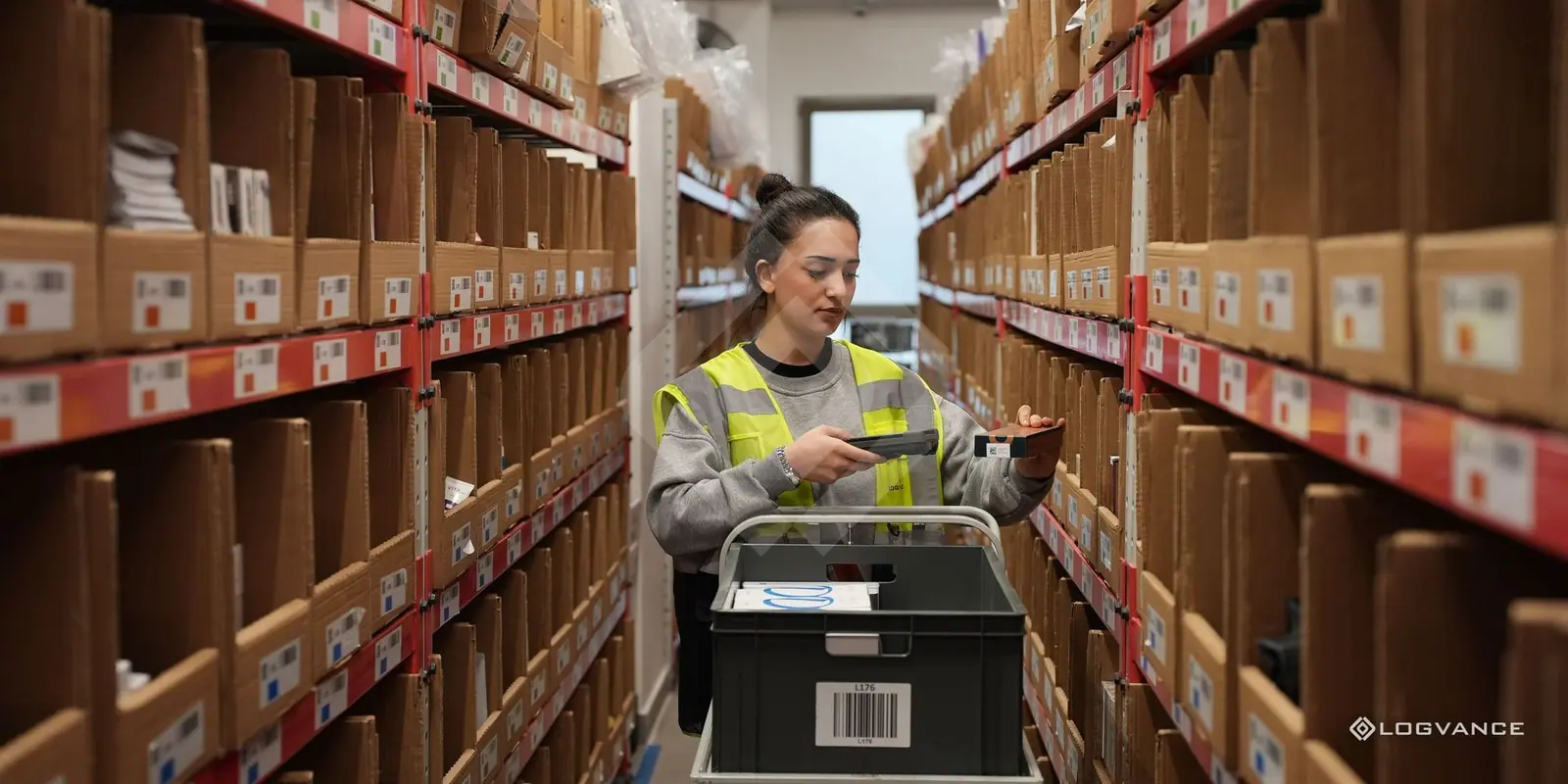
| Order picking | Orders are picked with system guidance and verified by barcode | The risk of wrong or short shipments is minimised |
| Packing | Carton and cushioning suited to the product; branded packaging, leaflets and gift notes added | Damage-free delivery and an unboxing that matches your brand |
| Shipping and distribution | Parcels are handed to contracted carriers; tracking information is written back to the channel | Shipping handled in one place; the tracking number reaches the customer automatically |
| Returns management | Returned items are checked; sellable items go back into stock | Returns go back on sale quickly |
| Value-added services | Labelling, kitting, gift boxing, shrink wrapping | Campaign and channel requirements are met in the warehouse |
How does the fulfillment process work at Logvance?
- Operations analysis: product list, sales channels, monthly order and return volume, product sensitivities and packaging expectations are assessed together; the quote is prepared from this data.
- Integration: your online store and marketplace accounts are connected to our warehouse management system. Orders drop in automatically; stock and shipping data are written back to the channels. Ready connections are listed on the integrations page.
- Stock transfer and goods receipt: your products arrive, are counted and scanned into the system. Products without barcodes are labelled at this stage.
- Live order flow: stock is reserved for every incoming order, a picking list is created, items are picked, packed and handed to the carrier.
- Returns and reporting: returns are checked and booked into stock. You follow stock, order and return movements in the system.
The safest transition starts with a limited product group or a single channel and opens the remaining channels once the flow is verified.
Cut-off time and same-day dispatch: what the conditions are
Orders are sorted around a 14:00 cut-off: orders that arrive before the cut-off on a working day are prepared for that day's carrier collection; orders after the cut-off go into the next working day's queue. Same-day dispatch applies to products that are physically in stock and to the carrier's collection schedule; marketplace and carrier rules, campaign peaks and public holidays can change the collection plan, and these exceptions are agreed with you in advance. Dispatch means handover to the carrier, not delivery to the customer; delivery time depends on the carrier and the destination.
Which sales channels do we work with?
The biggest operational risk in multi-channel selling is running each channel on separate stock: a product sold in one channel still looks available in another, and cancellations begin. At Logvance, orders from all channels are fulfilled from the same stock.
- Marketplaces: Trendyol, Hepsiburada, Amazon, n11, Pazarama.
- E-commerce platforms: Shopify, Ticimax, IdeaSoft, ikas.
- B2B orders: bulk orders for dealers, pharmacies and retail chains are prepared from the same warehouse and the same stock.
For marketplace-focused operations see marketplace logistics; for brands selling through their own site see e-commerce logistics.
Which product groups are we specialised in?
- Cosmetics and dermocosmetics: lot and expiry tracking, shipping by expiry date (FEFO), packing against breakage and leaks. Details: cosmetics logistics.
- OTC and food supplements: condition-controlled storage, lot-level traceability and, in a recall, knowing which lot went to whom. Details: OTC and healthcare logistics.
- General e-commerce products: accessories, home products, personal care, small electronics and similar categories with many SKUs and many channels.
How is fulfillment priced?
There is no single list price for fulfillment, because cost depends on product size, order structure and operational needs. The quote is built from these items:
| Cost item | What it depends on |
|---|---|
| Goods receipt | Whether goods arrive by pallet, carton or unit; whether they are barcoded |
| Storage | Space occupied (pallet, shelf bin) and stock turnover |
| Order preparation | Number of orders and items per order |
| Packaging material | Carton type, cushioning, branded packaging |
| Shipping | Volumetric weight, actual weight, destination and delivery speed; shown separately |
| Returns processing | Return rate and inspection requirements |
| Value-added services | Number of labelling, kitting and gift-boxing operations |
When comparing quotes, the most reliable measure is total cost per order: the sum of all items divided by the number of orders. Any worked example is an assumption, not a binding offer.
What should you look for in a fulfillment provider?
- Measured order accuracy: does the provider measure and share its error rate? Unmeasured accuracy stays a promise.
- Warehouse management system: can it show stock by SKU, lot and expiry date? Can you see stock movements yourself?
- Integrations: are your marketplaces and platform already connected, or is a separate software project needed?
- Product experience: are processes defined for your category, especially for sensitive products?
- Campaign capacity: how is the order surge in peak periods handled?
- Quote transparency: are minimum fees, long-term storage, returns and integration fees written down?
- Certification: has the provider passed independent audits in information security and quality management?
How are B2B and B2C orders managed in the same warehouse?
Many brands sell both to end consumers (B2C) and to dealers, pharmacies or retail chains (B2B). The two order types use the same product but different operations: a B2C order is single, small and fast; a B2B order ships by carton or pallet, with a delivery note and often a delivery appointment.
| Feature | B2C order | B2B order |
|---|---|---|
| Order size | A few items | Cartons or pallets |
| Preparation | Unit picking, parcel packing | Carton picking, palletising |
| Documents | Invoice and shipping label | Delivery note, invoice and, where needed, packing list |
| Delivery | Parcel carrier | Parcel, groupage or direct vehicle |
A worked scenario: one product, a dealer order and five marketplace orders
Assume one SKU with 300 sellable units in the warehouse. At 10:00 a dealer places a B2B order for 10 cartons of 24, that is 240 units. Within the same hour five single-unit orders arrive from two marketplaces. The system reserves stock in the order it receives: the dealer order takes 240, sellable stock drops to 60 and that figure is written back to every channel; the five marketplace orders take 5 more, sellable stock becomes 55. The same unit can never be sold twice, because reservation happens when the order arrives, not when it is picked.
The two flows are then prepared differently. The dealer order is picked by the carton, palletised, documented with a delivery note and loaded for a scheduled delivery. The marketplace orders are picked by the unit with barcode verification, packed as parcels and sorted by carrier for the 14:00 cut-off. Both are deducted from the same stock record, so nobody has to split inventory between warehouses or channels.
Two edge cases are decided by rules you define with us in advance. Short stock: had the dealer ordered 15 cartons (360 units) against 300, the system would reserve what exists and flag the shortfall; whether the order ships partially or waits for replenishment is your partial-shipment rule. A channel priority rule can also protect a minimum quantity for a given channel. Cancellation: if the dealer cancels before dispatch, the 240 reserved units are released and sellable stock is written back to the channels within the next sync. What is visible to you throughout is the same record: reserved, sellable, blocked and damaged quantities, by SKU and lot.
How do you monitor the fulfillment operation?
- Stock position: actual quantity in the warehouse by SKU, lot and expiry date.
- Order status: which orders are prepared, dispatched or waiting.
- Returns: the state of returned items and the quantities put back on sale.
- Performance indicators: order accuracy, dispatch time and stock accuracy. You can assess your own operation with the KPI assessment.
Why Logvance for fulfillment?
Logvance has managed logistics operations from storage to the end customer since 2019. We provide fulfillment from our warehouses in Ataşehir, Istanbul and from our warehouse in Neu-Ulm, Germany, with the same system and the same team.
- 99.99% order accuracy: our measured error rate in order preparation is 0.01%.
- Our own warehouse management system: stock, order and return movements are tracked by SKU, lot and expiry date. Details: Logvance WMS.
- Ready integrations: Trendyol, Hepsiburada, Amazon, n11, Pazarama, Shopify, Ticimax, IdeaSoft and ikas.
- Sensitive-product experience: condition-controlled storage for cosmetics, dermocosmetics, OTC and food supplements.
- Logistics under one roof: storage, customs clearance, international transport and value-added services in the same operation. See 3PL and contract logistics.
- Certifications: ISO/IEC 27001 information security, ISO 45001 occupational health and safety, a Quality Management System and GDP (Good Distribution Practice). All on the certificates page.
Share your product list, sales channels and monthly order volume and request a quote; we will work out the cost per order item by item for your operation.
Frequently asked questions
- What is a fulfillment service?
- A fulfillment service keeps an e-commerce brand's products in a logistics company's warehouse and picks, packs and ships orders from there. It covers goods receipt, storage, order preparation, packing, shipping and returns. The brand focuses on product and sales while the fulfillment company runs the operation.
- How is fulfillment priced in Türkiye?
- Pricing is built from goods receipt, storage space, number of orders, items per order, packaging material, parcel volumetric weight and destination, return rate and value-added services. Instead of a list price, a quote is prepared item by item from your product and volume data; shipping is shown separately.
- Do my marketplace orders reach the warehouse automatically?
- Yes. Your Trendyol, Hepsiburada, Amazon, n11 and Pazarama stores and your Shopify, Ticimax, IdeaSoft or ikas platform connect to our warehouse management system. Orders drop in automatically, stock and tracking data are written back to the channels, and all channels are fed from the same stock.
- Can an international brand use Logvance for fulfillment in Türkiye?
- Yes. Brands selling into Turkish marketplaces or to Turkish customers can combine import, customs clearance, storage and fulfillment with one logistics partner. Our warehouse in Neu-Ulm, Germany runs on the same system and team as the Istanbul warehouses. The quotation and onboarding process is handled in English.
- What does same-day dispatch mean here?
- Orders received before the 14:00 cut-off on a working day, for products physically in stock, are prepared for that day's carrier collection. Dispatch means handover to the carrier, not delivery. Carrier collection schedules, campaign peaks and public holidays can change the plan, and these exceptions are agreed in advance.
- Do you handle cosmetics and food supplements?
- Yes. We provide condition-controlled storage for cosmetics, dermocosmetics, OTC products and food supplements and track stock by lot and expiry date. Products closest to expiry ship first, and the system shows which orders carried a given lot.
- How long does onboarding take?
- It depends on the number of products, whether barcodes and product data are ready, the integrations needed and the size of the stock transfer. Ready marketplace and platform integrations shorten setup. Onboarding starts with a limited product group and expands once the flow is verified; the timeline is set after the analysis.